2026 Top PVC Film for Hospital Use How to Choose?

Time:2026-10-11 Author:Oliver
0%

Choosing Pvc Film For Hospital Use requires more than comparing gloss, thickness, or price. The film may cover medical mattresses, privacy equipment, protective surfaces, or packaging components. Each application creates different hygiene, flexibility, and durability demands. A film that performs well on a mattress may fail during repeated folding or heat cleaning. That detail is easy to overlook.

In 2026, buyers should examine documented material specifications before approving samples. Check thickness tolerance, tensile strength, tear resistance, transparency, surface finish, and welding performance. For patient-contact applications, request relevant biocompatibility evidence, chemical information, and plasticizer details. Cleaning agents can weaken some films. Repeated exposure matters. Ask how the material performs after rubbing, disinfecting, and storing under hospital conditions. Flame performance may also be important, depending on the intended location and local requirements.

Reliable selection depends on more than a supplier’s “medical grade” label. Review batch traceability, quality-control records, technical data sheets, and independent test reports. Confirm that the manufacturer can maintain consistent color, thickness, and roll length. A small trial should include real seams, corners, and cleaning routines, not only a flat sample. This guide compares practical criteria and highlights questions purchasing teams may miss. No film suits every hospital environment. That is the uncomfortable part. Final approval should involve engineering, infection-control, procurement, and regulatory professionals. Requirements vary by country and application, so current standards must be verified before purchase.
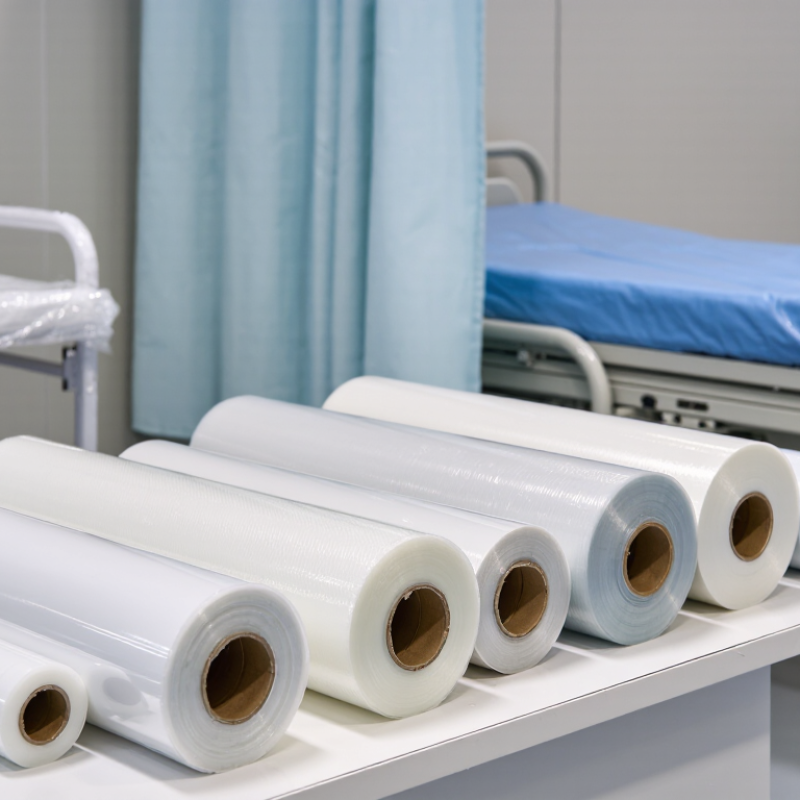
2026 Top PVC Film for Hospital Use How to Choose?

What Is PVC Film for Hospital Use?

What Is PVC Film for Hospital Use?

PVC film for hospital use is a flexible polyvinyl chloride sheet designed for controlled healthcare environments. It may cover mattresses, pillows, operating surfaces, privacy systems, wall panels, or medical packaging. Its value comes from practical performance: smooth cleaning, moisture resistance, weldability, and stable thickness. However, ordinary PVC film is not automatically medical-grade. Formulation, plasticizers, pigments, surface treatment, and manufacturing hygiene all matter.

The World Health Organization reports that about one in ten patients experiences harm during healthcare. More than half of this harm is considered preventable. Cleanable surfaces can support infection-control routines, but they cannot replace proper cleaning procedures. I would not choose film by thickness alone. A thick sheet may still crack at folded corners or soften under disinfectants. Testing should include chemical resistance, seam strength, tensile performance, and repeated wiping. For skin contact or packaging, suppliers should provide biocompatibility and safety documentation, such as ISO 10993 or ISO 11607 evidence, when applicable.

Tips: Ask for the intended-use specification, not only a product sample. Check performance after repeated disinfectant exposure. Confirm low odor, controlled migration, and traceable batch records. VinylPlus reported 810,775 tonnes of PVC recycling in Europe in 2023. This supports circular procurement, yet recycled content requires careful review for hygiene-sensitive applications. The weak point is often overlooked: a film can look clean while its surface is already damaged.

Which Medical-Grade PVC Film Properties Matter Most?

Medical PVC film for hospital use must do more than look clean and flexible. Its medical-grade formulation should support biocompatibility, low extractables, and stable performance during storage. Check test data based on ISO 10993 or equivalent evaluation methods. Plasticizers matter, too. Poorly selected additives may migrate into fluids or create odor concerns.

Mechanical properties deserve close attention. The film should resist puncture, tearing, and repeated bending around tubing or fluid bags. Clear visibility helps staff inspect particles, air bubbles, and fluid levels quickly. Seal strength is equally important, especially after heat sealing. A film may appear strong but fail at the seal. That detail is easy to miss. Sterilization compatibility must match the intended method, such as steam, radiation, or ethylene oxide. Repeated exposure can reduce flexibility or cause discoloration.

Tips: Request recent test reports, batch traceability, thickness tolerance, and aging data. Compare samples after sterilization, not only before it. Test them under realistic handling conditions. Include cold storage and warm transport if those conditions are possible. No film is perfect. A careful selection may still need redesign after pilot testing, because laboratory results cannot reproduce every hospital workflow. Ask an independent qualified laboratory to verify critical claims when patient contact or long-term storage is involved.

How Do PVC Film Types Match Different Hospital Applications?

2026 Top PVC Film for Hospital Use: How Do PVC Film Types Match Different Hospital Applications?

PVC film selection should follow the hospital task, not only thickness or price. Flexible, plasticized PVC film suits mattress covers, privacy curtains, fluid bags, and protective overlays. It bends around corners and seals well. Rigid PVC film provides stronger shape retention for sterile packaging, trays, and blister cavities. Transparent grades help staff inspect contents without opening the package.

Sterilization changes the decision. Steam exposure, gamma radiation, and ethylene oxide can affect clarity, strength, odor, and plasticizer migration. A supplier’s test data should cover the exact film, sealing method, and sterilization cycle. The WHO Global Report on Infection Prevention and Control estimates that 7 in 100 acute-care patients in high-income countries acquire at least one healthcare-associated infection. Surface films therefore need cleanability, low porosity, and verified chemical resistance.

Medical-plastics market data also shows why specifications are becoming stricter. Grand View Research reported a global medical plastics market size of about USD 37.9 billion in 2023, with continued growth expected through 2030. This figure includes several polymers, not PVC alone, so it should not be treated as PVC demand. That distinction matters. Hospitals should compare extractables, tensile strength, seam performance, and biocompatibility records. DEHP-free or alternative-plasticizer films may fit sensitive applications, but “safer” still requires application-specific evidence. A lower-cost film can become expensive after repeated tearing, cleaning failure, or rejected packaging.

How Can You Verify Safety, Compliance, and Product Quality?

2026 Top PVC Film for Hospital Use: How to Choose?

Hospital PVC film should be evaluated as a safety-critical material, not just a flexible plastic roll. Ask for the exact resin composition, plasticizer information, and intended application. Film used for mattress covers may require different evidence than film used near wound-care products. Check thickness, surface uniformity, odor, pinholes, and edge damage under bright inspection lighting.

Verify compliance through current, traceable documents. Request test reports from an ISO/IEC 17025-accredited laboratory, not only a supplier declaration. Review biocompatibility data when the film contacts skin or bodily fluids. Chemical migration, heavy metals, sterilization resistance, flammability, and aging results should match the final use. Confirm that the reports identify the same grade, thickness, and production site. A certificate for another product proves little.

Quality also depends on manufacturing control. Check lot numbers, retained samples, certificates of analysis, and change-notification procedures. Measure several points across the roll; thickness variation can affect sealing and barrier performance. A clean, sealed package matters in hospital storage. Ask how the supplier controls dust and moisture. Even strong documentation has limits. Tests may reflect laboratory conditions, not every hospital environment. Our inspection experience shows that a faint odor or inconsistent gloss can justify further testing, although neither finding alone confirms failure. Keep samples from each shipment and record what you actually observe.

How Should Hospitals Choose the Best PVC Film in 2026?

Hospitals should choose PVC film by clinical duty, not appearance or a low quotation. In 2026, the question is simple: what must the film survive? Fluid-bag film needs flexibility, low extractables, and secure welds. Mattress-cover film needs abrasion resistance, disinfectant tolerance, and stable seams. WHO identifies more than two million medical-device types worldwide. That scale makes one universal PVC specification unrealistic.

Start with a written risk profile. Define thickness tolerance, tensile strength, elongation, tear resistance, haze, odor, and surface cleanability. Request lot-specific certificates, test methods, and change-control records. For patient contact, ask for biological evaluation under ISO 10993-1. For sterile-barrier packaging, verify ISO 11607 performance and seal strength. FDA guidance explains that biological safety depends on the finished device, not simply the raw polymer. That distinction is often missed.

Cleaning data deserves close attention. The 2024 WHO/UNICEF JMP report found basic hygiene services in only 57% of health-care facilities globally. Films should be tested against the hospital’s actual disinfectant, concentration, temperature, and contact time. Do not trust a “medical grade” label alone. It is not a test result. Compare accelerated aging, odor after wiping, yellowing, tackiness, and microscopic cracking. I would also review disposal impacts and plasticizer migration. Cost matters, but cheaper film can create replacement labor, leakage, or infection-control concerns. The uncomfortable part: many teams test new film once, then assume every future lot behaves identically.

2026 Top PVC Film for Hospital Use How to Choose? - How Should Hospitals Choose the Best PVC Film in 2026?

Hospital PVC Film Selection Matrix — 2026 Procurement Reference
Selection Dimension Recommended Target or Range Why It Matters in Hospitals How to Verify
Intended application Select a specification for the actual use: privacy curtains, mattress or pillow covers, upholstery, protective sheeting, or fluid-resistant components. The required flexibility, thickness, cleanability, flame performance, and biocompatibility can differ substantially by application. Create an application-specific purchase specification before comparing samples.
Film thickness Common starting range: 0.15–0.50 mm. Use the higher end for heavy handling, upholstery, or repeated abrasion; validate thinner films for lightweight covers. Thickness affects tear resistance, puncture resistance, flexibility, drape, weight, and cost. Measure at multiple points with a calibrated thickness gauge; define the permitted average and local tolerance.
Mechanical strength Set minimum tensile strength, elongation, tear strength, and puncture resistance according to the finished product rather than relying on thickness alone. Hospital films may be pulled, folded, stretched over corners, or exposed to sharp edges during daily use. Use ISO 527 for tensile properties and an agreed tear or puncture method; test both machine and transverse directions where applicable.
Flexibility and low-temperature performance Require the film to remain flexible across the facility’s expected storage and operating temperatures; confirm the actual temperature range during qualification. A film that becomes stiff or brittle can crack at folds, seams, or corners. Perform conditioning and flex testing at the lowest expected temperature, using an agreed internal protocol.
Chemical resistance Demonstrate compatibility with the hospital’s approved disinfectants, including the stated concentration, contact time, temperature, and number of wipe cycles. Alcohols, chlorine-based products, oxidizers, and other cleaners can cause swelling, tackiness, discoloration, embrittlement, or loss of strength. Test cleaned samples for visual change, mass change, tensile properties, flexibility, and surface tack after repeated exposure.
Fluid barrier performance For moisture-protection applications, specify a continuous, pinhole-free film and define the required hydrostatic or leakage resistance. A visually smooth surface does not by itself prove resistance to body fluids, cleaning liquids, or seepage through defects. Use a documented liquid-barrier or hydrostatic-pressure test and inspect seams, welds, and converted edges separately.
Surface and cleanability Prefer a uniform, nonporous, low-tack surface without exposed voids, deep texture, or defects that can retain soil. Surface geometry affects wipe efficiency, visible contamination, drying time, and long-term appearance. Evaluate cleaning with the facility’s real disinfectant and wiping process; record gloss, color, tack, and microscopic surface damage.
Plasticizer and extractables Use a documented plasticizer system suitable for the application; apply stricter material and extractables controls when there is prolonged skin contact, fluid contact, or device use. Plasticizer migration can affect odor, flexibility, surface feel, adjacent materials, and biological safety. Request a complete composition statement and test extractables or migration under the intended conditions. Do not accept “medical grade” as a substitute for evidence.
Biocompatibility For patient-contacting products, perform a risk-based biological evaluation; indirect or brief contact may require a different assessment from prolonged contact. Biological safety depends on the final formulation, processing, additives, contact type, and contact duration. Use ISO 10993 principles where applicable and assess the finished article, including inks, adhesives, coatings, and seams.
Flammability Specify the fire-test classification required by the hospital, building code, and end-use location; do not use a generic flammability claim. Requirements can differ for curtains, furnishings, equipment covers, and areas near oxygen or ignition sources. Require an independent laboratory report to the exact test method and edition named in the purchase specification.
Sterilization suitability Never assume that PVC film is suitable for steam autoclaving. Qualify the specific film for ethylene oxide, radiation, or another validated process when sterilization is required. Heat, radiation, and sterilant exposure can change color, flexibility, strength, odor, or plasticizer content. Test the film after the maximum validated sterilization cycles, including packaging and storage conditions.
Dimensional stability Define allowable shrinkage, curl, and warpage after heat, cleaning, storage, and conversion. Dimensional change can create gaps, wrinkles, seam stress, poor fit, or trapped-fluid areas. Measure marked samples before and after conditioning using a documented temperature, time, and humidity profile.
Odor and fogging Set an acceptable odor level and require low visible residue or fogging where the film is used in enclosed patient areas or near optical surfaces. Odor and volatile residues can affect patient comfort, staff acceptance, and nearby equipment surfaces. Conduct conditioned-sample odor evaluation and inspect for volatile deposits after aging and cleaning.
Color and opacity Define color tolerance, opacity, and light transmission according to privacy, visibility, wayfinding, and inspection needs. Consistent appearance supports facility standards, while suitable opacity can improve privacy without preventing visual checks. Use instrumental color measurement where appearance is critical and inspect samples after disinfectant and UV exposure.
Regulatory and restricted-substance documentation Require a current technical data sheet, safety data sheet, composition or restricted-substance declaration, test reports, and lot traceability. Documentation enables risk assessment, change control, incident investigation, and compliance with applicable local requirements. Verify applicable requirements such as REACH, RoHS, chemical restrictions, medical-device rules, and local fire regulations for the destination market.
Quality consistency and traceability Require batch identification, retained samples, defined release tests, and notification before changes to resin, plasticizer, coating, colorant, or process. Consistent quality is essential when film is converted into repeated hospital products or supplied across multiple sites. Audit the quality system and compare incoming-lot results against the approved master sample and specification.
Sustainability and end-of-life Evaluate recycled-content claims, packaging reduction, service life, and realistic local recycling routes without compromising hygiene or safety. A longer service life may reduce replacement waste, while contaminated or multilayer products may not be accepted in ordinary recycling systems. Request evidence for environmental claims and confirm disposal requirements with the healthcare facility and local waste contractor.
Important procurement note: The ranges above are starting points for specification development, not universal pass/fail limits. Final acceptance criteria should be based on the completed product, intended patient contact, cleaning protocol, fire requirements, sterilization method, and applicable regulations in the destination market.

FAQS

What properties matter most in medical PVC film?

Look for biocompatibility, low extractables, flexibility, and stable storage performance. The film should resist punctures, tears, and repeated bending. Clear surfaces help staff see bubbles, particles, and fluid levels.

How can plasticizer safety be evaluated?

Request plasticizer details and migration data. Poorly selected additives may enter fluids or create odors. Review testing for the exact film grade and intended application.

Why is seal strength important?

A film can look strong but fail at the sealed edge. Test heat-sealed samples under realistic handling. Inspect seals after bending, pulling, and storage.

Which sterilization conditions should be tested?

Match testing to the intended method, including steam, radiation, or ethylene oxide. Compare samples before and after sterilization. Repeated exposure may reduce flexibility or cause discoloration.

What documents should a supplier provide?

Request recent test reports, batch traceability, thickness tolerance, aging data, and certificates of analysis. Reports should identify the same grade, thickness, and production site. Another certificate proves little.

How should the film surface be inspected?

Use bright lighting to check thickness variation, pinholes, odor, edge damage, and uneven gloss. Measure several points across the roll. Small defects can affect sealing and barrier performance.

Does laboratory testing guarantee hospital performance?

Not completely. Laboratory conditions cannot reproduce every hospital workflow. Test samples during cold storage, warm transport, and repeated handling when relevant. A redesign may still be needed.

How should shipment quality be monitored?

Keep retained samples from every shipment and record actual observations. Check sealed packaging, dust control, moisture protection, and lot numbers. A faint odor deserves review, but it does not prove failure.

Conclusion

Pvc Film For Hospital Use is a specialized material designed to support hygiene, protection, and reliable performance in medical environments. When selecting it, hospitals should focus on key properties such as flexibility, clarity, tensile strength, chemical resistance, waterproof performance, low-temperature stability, and ease of cleaning. The film should also be suitable for contact with medical equipment, packaging, protective coverings, fluid barriers, and other healthcare applications without compromising durability or safety.

In 2026, hospitals should match the PVC film type to its intended use, considering thickness, softness, transparency, sterilization compatibility, and resistance to aging or tearing. Safety and quality verification are equally important, including reviewing technical data, testing reports, traceability information, and compliance documentation from qualified suppliers. A well-informed purchasing decision should balance performance, consistency, application requirements, total cost, and dependable supply, helping hospitals select a safe and practical PVC film solution for long-term use.


Oliver

Oliver

Oliver is a seasoned marketing professional with a wealth of expertise in driving brand awareness and engagement. With a deep understanding of our company's product offerings, he consistently delivers high-quality content that enriches our professional blog. His insights not only shed light on......